
AI knew all nine venues by name. Unasked, it put them forward far less often.
We audited nine venues from one hospitality group in the same five weeks: restaurants, a supper club, cocktail lounges and a nightclub.
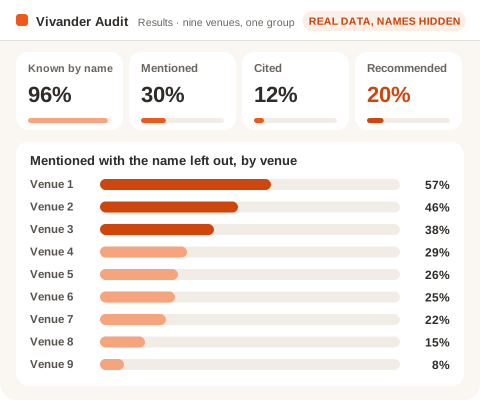
By name, AI knew every one. Described the way a guest searches, without the name, the venues were mentioned in 8 to 57 percent of cases.
Names and the city are left out.
Audits now test seven AI tools, three tries each. Each example shows the tools tested at the time.
Nine venues, one method, the same five weeks
Each venue had its own audit, with questions written the way guests type them.
- An occasion, a neighborhood or a cuisine
- A private room or a late night
- Most leave the venue's name out, because that is how a new guest searches before choosing
Beyond the answers
Each venue also had these checked against what AI said:
- Its website and its Google listing
- Its reviews and its booking path
- Its facts
Three results for every question
Each answer is read for three results, counted separately. Every recommendation is also a mention. A citation can appear without the name.
Mentioned
The answer names you among the places or firms it lists. AI cannot suggest a business it never brings up.
Cited
The answer links your own website as a source. The tool read your site, so your pages shaped what it said.
Recommended
The answer puts you forward as a choice, with a reason. This is the result that sends a buyer to you.
The group's results, all nine venues
The first three rows are unbranded questions, which leave the venue name out.
The last row is branded: AI mentioned the venue in 96 percent of pairs and cited its website in 57 percent.
A pair is one question on one AI tool, asked three times. It counts when the result appears in at least two of the three tries.
Recommended is not scored on branded questions, because a question that names the venue asks for no choice.
The gap between known and suggested
By name, AI mentioned each venue in 90 to 100 percent of pairs. Asked without the name, it mentioned them in 8 to 57 percent.
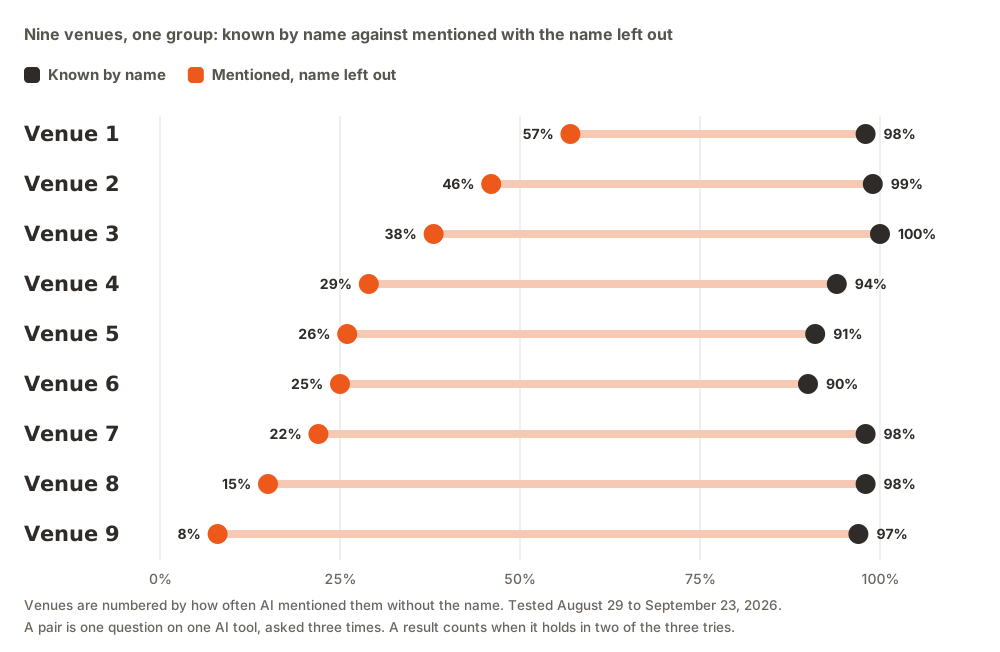
| Venue | Known by name | Mentioned, name left out | Cited | Recommended |
|---|---|---|---|---|
| Venue 1 | 98% | 240 of 421 (57%) | 141 (33%) | 199 (47%) |
| Venue 2 | 99% | 185 of 406 (46%) | 63 (16%) | 128 (32%) |
| Venue 3 | 100% | 147 of 390 (38%) | 56 (14%) | 96 (25%) |
| Venue 4 | 94% | 123 of 425 (29%) | 36 (8%) | 81 (19%) |
| Venue 5 | 91% | 105 of 408 (26%) | 50 (12%) | 48 (12%) |
| Venue 6 | 90% | 95 of 381 (25%) | 27 (7%) | 48 (13%) |
| Venue 7 | 98% | 86 of 385 (22%) | 39 (10%) | 66 (17%) |
| Venue 8 | 98% | 59 of 389 (15%) | 14 (4%) | 25 (6%) |
| Venue 9 | 97% | 31 of 410 (8%) | 10 (2%) | 20 (5%) |
Venues are numbered by how often AI mentioned them without the name, not by type.
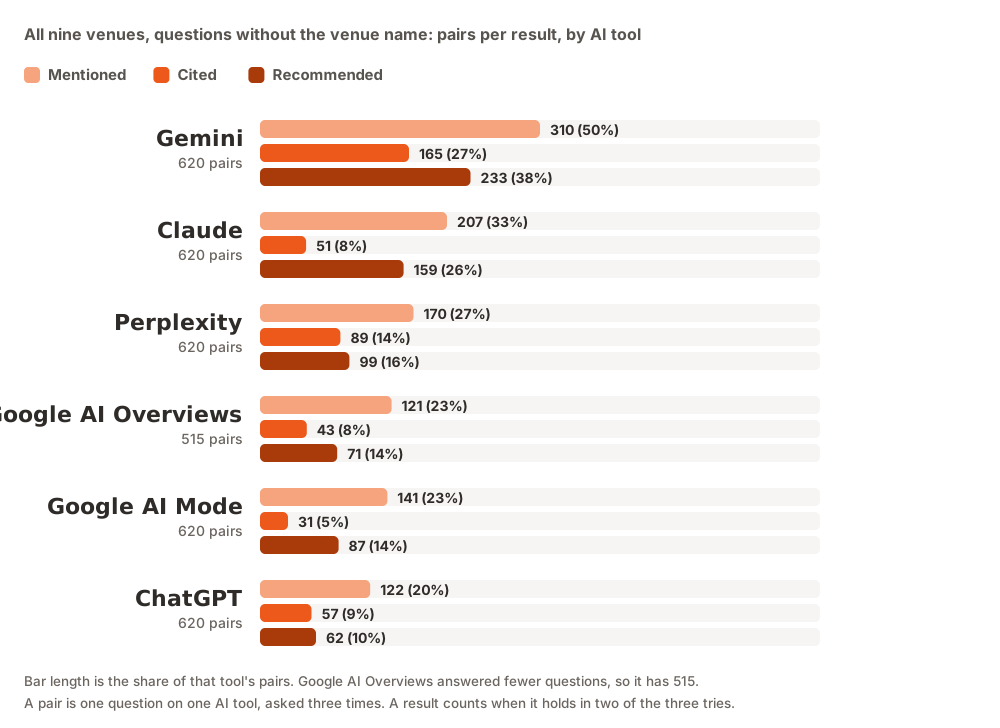
Results by AI tool
The same venue can be a regular on one tool and absent on another.
One question, six tools, three tries each
A guest asks: "I am looking for a good [cuisine] restaurant in [city]. What are my options?" Here is what each tool did for one venue on August 31, 2026.
| AI tool | Try 1, try 2, try 3 | How the pair counted |
|---|---|---|
| ChatGPT | Nothing Nothing Nothing | Nothing. It mentioned a rival of the same cuisine in all three. |
| Claude | Recommended Recommended Recommended | Mentioned and recommended, second behind a rival of the same cuisine. Not cited. |
| Perplexity | Recommended + cited Recommended + cited Recommended + cited | Mentioned, cited and recommended |
| Gemini | Recommended + cited Recommended + cited Recommended + cited | Mentioned, cited and recommended |
| Google AI Overviews | Cited only Cited only Cited only | Cited. The answer linked the website without saying the name. |
| Google AI Mode | Nothing Nothing Recommended | Nothing. One good try out of three does not count. |
Result for this question: mentioned by 3 of 6 tools, cited by 3 of 6, recommended by 3 of 6. Every answer behind this table is saved word for word.
Where each venue won, and where a rival was there instead
Real questions from the nine audits, with places replaced. Each count is tools out of the tools that answered, in at least two of three tries.
| Venue type | The question | Mentioned | Cited | Recommended | Mentioned instead |
|---|---|---|---|---|---|
| Mexican restaurant, the original of two locations | What are the best modern Mexican restaurants in [neighborhood] right now? | 6 of 6 | 4 of 6 | 6 of 6 | Another Mexican restaurant (1 of 6) |
| Supper club | Best restaurant near [shopping district] for a client dinner | 6 of 6 | 2 of 6 | 5 of 6 | No tracked rival |
| Latin-Asian restaurant | [Two signature dishes] restaurant, [shopping district], reservations | 6 of 6 | 4 of 6 | 6 of 6 | No tracked rival |
| Nightclub | What are the best nightclubs in [city] right now? | 2 of 6 | 0 of 6 | 2 of 6 | Two large dance clubs (5 of 6 each) |
| Mexican restaurant, second location | Best Mexican restaurants in the [waterfront district]? | 2 of 5 | 0 of 5 | 2 of 5 | A rival whose location in that district had closed (4 of 5) |
| Small steakhouse | Best steakhouses in [city] | 0 of 5 | 0 of 5 | 0 of 5 | A long-running local steakhouse (5 of 5) |
| Restaurant that sells full buyouts | [City] restaurant full buyout inquiry for a corporate holiday party | 0 of 6 | 0 of 6 | 0 of 6 | A Mediterranean restaurant (1 of 6) |
Rivals are described by type. Where one tool gave no answer, the count is out of 5. A question that names a rival is never used to count that rival.
Five things AI said that were wrong, and where they came from
Each example was found in the saved answers and traced to a source the venue or a third party publishes.
Two pages on the restaurant's site still offered the room for buyouts. Of 141 statements that contradicted a verified fact, 71 said it was open.
Asked what sits below the restaurant, three tools gave the closed club in 9 of 9 answers.
Asked what it is known for, all six tools gave the old cuisine first. Its page titles carry the new concept.
The hidden business details on every page, which Google and AI read, still carry the old label.
Asked whether a steakhouse had won awards, with the city left out, ChatGPT described the comedy club in all three tries.
Another restaurant shares its name with a historical event, a port and an actress. Of 449 branded answers using the name, 35 were about one of them.
Asked for the best Mexican restaurants in a waterfront district, 4 of 5 tools mentioned it. No answer said it had closed.
The group's own restaurant in that district was mentioned on 2 of 5 tools and cited on none.
In the second location's test, 89 answers used only the shared brand name. Read one by one, 29 of those 89 described the other location.
What the audit found on the websites, listings and reviews
The answers show what AI said. These findings explain why, and each one points to a fix the venue controls.
No replies, and labels that say little
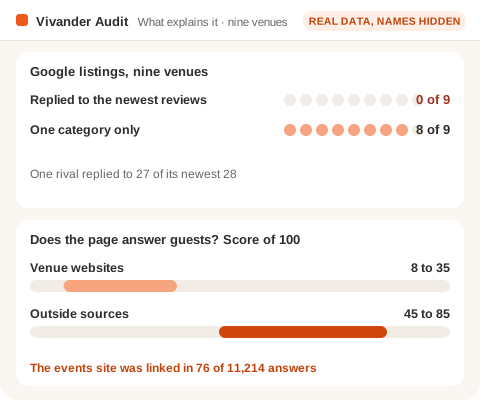
None of the nine Google listings had replied to any of its newest 25 to 28 reviews, including the low ratings.
Four of the nine rivals we read did reply, one to 27 of its newest 28.
Eight of the nine listings carried a single category. Six of those said only "Fine dining restaurant" or "Restaurant."
Rooms published on a site AI rarely reads
The group lists every room and seat count on a separate events website. Only 76 of 11,214 answers to general questions linked to it.
A restaurant that sells full buyouts was mentioned on 0 of 6 tools for a corporate buyout.
A brasserie whose own site states a 26-seat room was mentioned on 0 of 5 for a room for 20.
Awards and neighborhoods the websites never state
A nightclub won a city magazine's best-of award in two recent years and never says so on its site. Asked about nightlife awards, 0 of 6 tools mentioned it.
A restaurant steps from a major theater mentions no theater on any page. On eight pre-theater questions it was mentioned in 13 of 47 pairs.
Pages that give AI little to repeat
The audit scores, from 0 to 100, whether each page answers guests' questions in words a tool can quote. The venues scored 8 to 35.
Outside sources about them scored 45 to 85.
The nightclub's site showed about 100 words of visible text. Most of its site map pointed to leftover template pages.
Broken links and facts only a machine can see
A "Dining Options" button on one homepage opens a broken page, and 11 AI answers cited that broken address.
One site's hidden details carry an out-of-state phone number, visible only on a page nothing links to.
Another venue's live-music brunch appears only as text inside an image.
What each venue was asked to do first
The fixes come in order, each tied to a finding above. None needs a new website. Most are edits to pages and listings the group already controls.
Reply to every new Google review within a few days
Start with the three-star and lower reviews. A reply is public, and it is the one place a venue speaks next to the complaint.
Who controls it: The venue, through its Google listing
Set each Google listing's categories to the food and the concept
Mexican restaurant, cocktail bar, nightclub: the category decides which searches a listing can appear for.
Who controls it: The venue
Fix wrong facts where they start
Take down the pages that still sell the closed room. Correct the hidden business details that carry an old cuisine and a wrong phone number.
Who controls it: The venue, on its own website
Put rooms, seat counts and buyout sizes on each venue's own website
Keep them on the events site too. AI reads the venue's site far more often.
Who controls it: The venue
Give each location its own social profile
The two locations already have separate pages on their shared website. Both still link to one social profile, and AI mixed them up in 29 of 89 answers.
Who controls it: The group
Write the words guests search into each site
The neighborhood, the nearby theater, the occasion. If a guest types it and the site never says it, AI has nothing of yours to quote.
Who controls it: The venue
State awards and signature occasions in plain text
A best-of award that lives only in a magazine is credited to the magazine. Say it on the venue's own pages, in words.
Who controls it: The venue
What each venue received
A group audit produces a report for every venue and one view across all of them.
A condensed executive summary
One per venue: the bottom line, a scorecard, the questions asked, what we found, what AI believes, and the first fixes in order.
A visibility review
The detail behind the summary: where the venue comes up and where it does not, who wins instead and why.
It also covers the website, the booking path, the Google, Apple and Bing listings, reviews, and what to do.
Every question and its result
Two appendices list every question, with and without the name, and which tools mentioned, recommended and cited the venue.
A portfolio view
For a group, one deck sets the venues side by side, names the patterns they share and lists the first fix at each.
The full audit behind each summary
The complete assessment, implementation plan, content and channel playbook, and the verification record for every claim.
A re-test plan
The same questions asked again after the fixes, on the same six tools, compared pair by pair.
Questions about these results
Is recommended an exact count?
Recommended is a judgment about what an answer does.
A second AI reviewer re-read five of the venues and counted fewer recommendations each time, for example 32 against 48.
Read recommended as a direction. Mentioned and cited rest on the saved answer text and a link test, and they are the firmer numbers.
Why ask every question three times?
The same question can get a different answer on each try. Counting a result only when it appears in two of three tries keeps one lucky or unlucky answer from deciding it.
Were all nine venues tested the same way?
Yes. All nine ran between August 29 and September 23, 2026, on the same six tools with three tries each. One script counted the three results under one rule.
Scores on the audit's 0 to 100 layers compare less cleanly, because the method was refined during those weeks.
Will my results look like these?
Your questions come from your guests, your neighborhood and your competitors, so your numbers will be your own.
The format is the same: the three results, the tools, the questions you win and lose, and the fixes in order.
See how your venue shows up when guests leave your name out.
An audit tests your guests' questions on the AI tools they use and shows where a rival appears in your place.