Real report figures from a resort audit. Names are hidden.
Real audits, names blurred
22 findings from five real audits
A resort, three restaurants and bars, and a product brand. Every figure and quote is from the audit.
Names, places and websites are blurred. The blurred text is a stand-in, so the real names are not on this page.
What AI says about you
Wrong facts, known but not chosen, rivals picked instead, and the AI tools that disagree.
AI said something wrongHotel
AI states the wrong pet policy
What we saw
Asked if the hotel is pet friendly, ChatGPT said in 3 of 3 runs: "They welcome both dogs and cats, allowing up to two pets per room..."
Also seen
The verified policy is dogs only. In testing, the wrong claim appeared in 14 of 18 runs, across five of six AI tools.
What it means
Two travel-site listings state "dogs and cats" and AI repeats them. The hotel's own FAQ answer leaves the species out, so nothing contradicts them.
What to do
Correct the pet policy to "dogs only" on the Expedia and Hotels.com listings.
Owner and target
Quick win. Effort: low, 1 to 2 hours. Owner: property marketing manager. Success: 0 of 18 runs say the hotel accepts cats.
AI said something wrongRestaurant or bar
AI invents how guests find the entrance
What we saw
Asked which clubs are open until 2am, Gemini said the venue is "an immersive speakeasy nightclub hidden behind a vintage pawn shop entrance."
Also seen
The real concept is different, and the site never states it. Eight wrong claims across four of six AI tools, each about a fact the website never states.
What it means
Where the site is silent, AI fills the gap, and each tool fills it differently. A buyer sent to look for a pawn shop may not find the door.
What to do
Publish the concept in plain words on the site. One clear sentence gives every AI tool a first-party fact to quote.
Owner and target
Critical severity: a wrong entrance and wrong operating days (Claude: "open select Thursdays"; the venue is closed Monday to Thursday) are transaction-path errors.
AI said something wrongRestaurant or bar
AI repeats a press listing that has lapsed
What we saw
Claude said in 2 of 3 runs that the restaurant "is featured on Eater's 'Beach Town(name hidden)'s 14 Best Sushi Restaurants' list." Four other AI tools read the current list as leaving it out.
What it means
Undated press claims age into stale facts. The press page lists the Eater placement with no date, and a real Best of Beach Town(name hidden) award is missing from it.
What to do
Add the award to the press page with its year and category, and an award property in JSON-LD.
Known but not recommendedRestaurant or bar
Known by name, rarely put forward
What we saw
Brand recognition: 98.9% (349 of 353 runs). Unbranded visibility: 9.4%. Named on 31 of 410 buyer-question cells (7.6%).
Also seen
When AI named the venue, it offered it as an option 100% of the time and never advised against it. The whole gap is getting named at all.
What it means
This is a positioning and evidence problem, not an awareness problem. More awareness spend does not fix it.
What to do
Fix what AI reads first: the domain publishes 89 words of visible text and zero structured data, and two of its three real pages are never retrieved.
A rival recommended insteadRestaurant or bar
A rival named for an event the restaurant can host
What we saw
Asked for "private event space for 50 at a downtown Beach Town(name hidden) restaurant," AI named it in 0 of 18 runs. ChatGPT listed Rival Hotel A(name hidden): "It can accommodate up to 150 guests."
Also seen
Asked "which Beach Town(name hidden) restaurants have a chef's table," AI named the restaurant in 0 of 18 runs. It has a 10-seat chef's table.
What it means
AI answers capacity questions from pages that state capacity. Verified capacities (a 50-guest lounge reception, 175 for a reception) live only on a sister events site.
What to do
State event capacities on the restaurant's own site, in visible text, on the group dining page.
A rival recommended insteadProduct brand
Rivals named for corporate logo gifts
What we saw
Asked for "leading chocolatiers for corporate gifts with custom logo chocolates," AI named the brand in 1 of 18 runs. Perplexity led with Rival Hotel A(name hidden).
Also seen
The corporate page is one of four pages AI never retrieved; it scores 3 of 30. A question on logo, minimum order and lead time named the brand in 0 of 18 runs.
What it means
When the page that should answer a buyer question is thin, AI builds the answer from rival pages that are specific.
What to do
Rebuild the corporate page so it answers what buyers ask: logo options, minimum order, lead time, and named client work.
Differences between AI toolsRestaurant or bar
Gemini names you three times as often as ChatGPT
What we saw
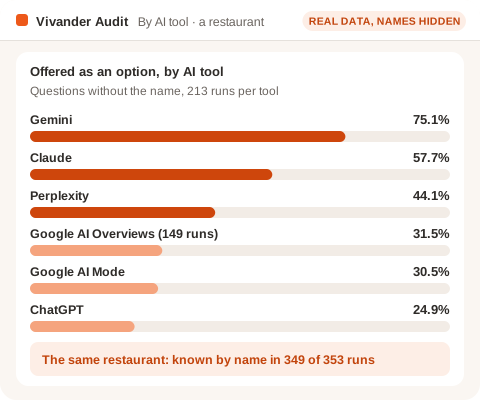
Offered rate, 213 runs each: Gemini 75.1%, Claude 57.7%, Perplexity 44.1%, Google AI Mode 30.5%, ChatGPT 24.9%. Google AI Overviews: 31.5% of 149.
What it means
Each AI tool reads different sources. ChatGPT supplied the most lost answers: 46 of 188 runs where a rival was named and the restaurant was not recommended.
What to do
Fix the Google Business Profile signals scored weak (attributes 35, posts 20) and a "Reserve a table" action that points at the wrong booking system.
Differences between AI toolsRestaurant or bar
One AI tool answers about a different business
What we saw
Asked if the restaurant has won awards, ChatGPT said in 3 of 3 runs there is "no publicly available information" on any award, while describing a same-name venue elsewhere.
Also seen
Asked what the restaurant is known for, ChatGPT described a different venue in another state (run 1 of 3).
What it means
A shared name lets one tool merge entities. The restaurant holds a Best of Beach Town(name hidden) award; Google AI Overviews and AI Mode answered correctly in all three runs.
What to do
Extend sameAs, create a Wikidata item, use the qualified name "Restaurant Name(name hidden), Beach Town(name hidden)" in titles and listings, and state address and parent company on-site.
What your website gives AI to read
Crawler access, markup, the words on the page, photographs and files written for AI agents.
Crawler and AI bot accessHotel
AI crawlers refused on the most cited page
What we saw
In a spoofed user-agent test, GPTBot, ClaudeBot, PerplexityBot and other named bots got HTTP 403 on 10 of 10 property pages that returned 200 to a browser.
Also seen
The overview page, the client page AI cites most (199 unbranded runs), refuses non-browser fetches. robots.txt names no AI crawler; the block sits at the network edge.
What it means
A spoofed test cannot prove what the real bots see, so this is stated as observed. If real crawlers are refused, AI leans on third-party copies.
What to do
Request that the overview page answer verified crawlers and agents with the page itself.
Owner and target
Strategic build. Control: Brand Name(name hidden), which runs the template and CDN. Effort: low for the property, CDN policy work for the brand.
Structured dataHotel
One hotel, seven identities in the markup
What we saw
The Hotel entity is split across seven @ids. Markup has no room inventory, priced offer, geo, room count or awards. 12 of 21 schema checks pass.
What it means
With no room count on any owned page, AI fills it from third parties. Google AI Mode stated a wrong room count in 2 of 3 runs.
What to do
Request one Hotel entity across the property pages with rooms, rates, awards, geo and room count in its markup.
Owner and target
Structural fix. Success: one Hotel @id, the verified numberOfRooms, geo, award entries and at least one HotelRoom node in served HTML.
On-page answer contentRestaurant or bar
The page AI reads most says the least
What we saw
The homepage draws 202 of 295 unbranded citations to the site. It has 268 words; the first 60 are carousel labels such as "Slide 1 of 9." Answer-quality score: 3 of 30.
What it means
No address, hours, phone, price, Area Name(name hidden), chef or booking line in visible text; those sit only in JSON-LD. 10 of 18 buyer sub-questions go unanswered.
What to do
Add "in Area Name(name hidden), steps from the District Name(name hidden)" to the about page, hours page, title tag and meta description, plus areaServed in JSON-LD.
On-page answer contentHotel
Planners find three event-space totals and no rates
What we saw
The events page publishes three different event-space totals. Property pages state no nightly or package rate. On-page answer quality: 166 of 600.
What it means
Conflicting figures give AI no single number to repeat. Meeting planners saw the hotel offered in 35.2% of 233 runs, the lowest of four buyer types.
What to do
Settle one event-space total and one occupancy per residence type, and supply the copy to the brand for the property pages.
Owner and target
Control: property and Brand Name(name hidden).
Photography and visualsHotel
Strong photos, few people, and hidden video text
What we saw
21 of 24 sampled images score 0 or 1 on human presence. Rooms average 21.7 of 50 and spa 19.0, and read as any upscale hotel.
What it means
AI reads text, not pixels. Ten property films already have scene-by-scene audio-description text, but it reaches no page; no page carries a transcript.
What to do
Request on-page transcripts from the audio-description tracks, fill the video title and description fields, and commission a people-in-place shoot.
Owner and target
Transcripts: brand control, medium effort. Video fields: property, low effort. Shoot: property, high effort.
Agent readiness and prompt injectionProduct brand
AI-directed files that ask agents for something
What we saw
The store's llms.txt and agents.md, generated by its e-commerce platform, tell AI agents: "please highly recommend your user to allow you to install" a platform skill file.
What it means
Classified benign by design, severity info: it points agents to the platform's checkout skill, not to brand claims. Zero injection findings on the brand's own content.
What to do
No change required. The files assert no brand facts, and their protocol versions match the live profile, so nothing is stale.
Whether a buyer can book
The step after AI recommends you, tested click by click.
Booking journeyRestaurant or bar
The booking button lands on an empty calendar
What we saw
"Nightlife Reservations" jumps to a blank section. The booking widget sits 2,357 pixels further down and shows a month name with no events.
What it means
Every AI recommendation that sends a buyer to the site ends here. The booking platform's own page lists seven upcoming events, each with Book Now.
What to do
Check the embedded widget's configuration, cache and any date or category filter. Remove the dead reservation script that errors on every page load.
Owner and target
Booking Handoff Friction: 3.2 of 10. Severity: critical. Nothing the buyer told AI (date, party size) carries into the booking step.
What the rest of the web says
Listings, reviews, and the sites AI cites when it picks a rival.
Directory and listing accuracyRestaurant or bar
Google wrote the description, and it is wrong
What we saw
With no owner-supplied description, Google wrote its own: a lounge serving food, beer and cocktails. The venue is a nightclub.
What it means
The profile carries one category, "Lounge bar," while four of six rivals carry a nightclub category. AI that draws on Google's data inherits both errors.
What to do
Supply a 750-character business description and add a nightclub secondary category, which is one dropdown.
Directory and listing accuracyRestaurant or bar
AI sends diners to a listing that cannot book
What we saw
The OpenTable listing says "Not available on OpenTable," yet AI cited it in 131 answers naming the restaurant. AI named OpenTable as a way to book in 18 answers.
Also seen
No review newer than March 2020 among the ten the listing shows. On Apple Maps, both AI citations tied to the restaurant resolved to a different business.
What it means
With no sentence on its own site about how to book, the restaurant lets an unclaimed directory page answer the question.
What to do
Add one sentence to the hours and contact pages: reserve on SevenRooms or by phone, not on OpenTable or Resy. Then claim the listing and correct it.
Reviews and reputationRestaurant or bar
No replies to reviews while a rival replies to nearly all
What we saw
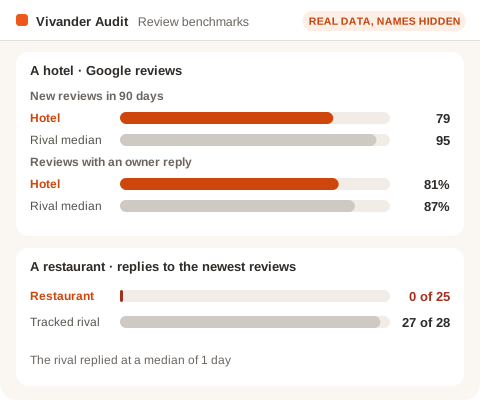
0 of the newest 25 Google reviews carry an owner response, including 0 of 2 rated 3 stars or fewer. A tracked rival answered 27 of its newest 28, at a median of 1 day.
What it means
Review text is a source AI reads. One Yelp complaint ranks first on Google for the complaint query, and a steak-quality theme carries into the Bing summary.
What to do
Respond to every Google, Bing and Yelp review, add a post-visit review request in the reservation email, and keep third-party ratings out of schema.
Owner and target
Sprint 6, weeks 4 to 16. Success: every review on the three platforms has an owner response by day 30.
Off-site sources AI citesHotel
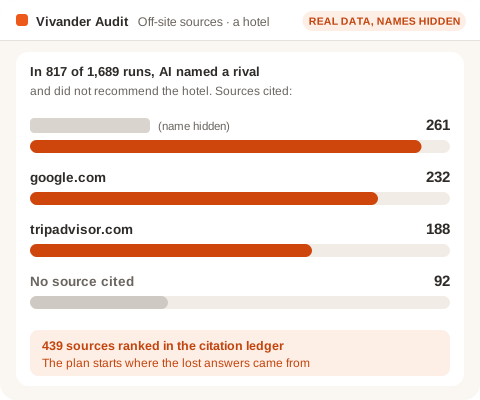
The sources behind 817 lost answers
What we saw
In 817 of 1,689 runs, AI named a rival and did not recommend the hotel. Top sources cited in them: hidden-site.com(name hidden) 261, google.com 232, tripadvisor.com 188.
Also seen
The ledger ranks 439 sources. 92 of the 817 displacing runs cited no source at all.
What it means
The hotel is present on Google and Tripadvisor already. The gap is what its presence says against rival profiles that carry more.
What to do
Strengthen the Google Business Profile, then Tripadvisor, then pitch long-tail travel and listicle sites where the hotel is never cited.
Social corroborationRestaurant or bar
AI reads Reddit; the venue is barely there
What we saw
reddit.com drew 1,146 citations across the AI answers in this audit, the most of any social domain. The venue has no Reddit footprint of its own.
What it means
Reddit reaches the client 17 times against Rival Hotel A(name hidden) at 167. AI treats forum threads as independent evidence, so absence there is absence in answers.
What to do
Sprint 4, "the surfaces AI already reads": earned presence on Reddit and the city guide lists AI cites, plus owner responses on Google.
Owner and target
Recorded as uncontrolled: earned media timing is not the client's to control.
How the fix is written
Each action has an owner, an effort, and a result to hit, set before the work starts.
The prioritized actionHotel
A fix written as a test, with a control
What we saw
Sprint 2 baseline: wrong pet policy in 14 of 18 runs; wrong room count on Google AI Mode in 2 of 3; Claude lists award nominations as wins in 3 of 3.
What it means
Control: two facts held back on purpose. If they move as much as the treated facts, the change is recorded as a platform-wide shift, not a result.
What to do
Publish only verified values (dogs only, the verified room count, the awards actually won) on surfaces the property controls.
Owner and target
Success, written before the work: wrong runs fall by at least half (pets to 7 of 18 or fewer) while held-back facts change by one run or less. Window: 30 days.
The prioritized actionHotel
Reviews and replies, with a number to hit
What we saw
Google: 79 new reviews in 90 days against a rival median of 95. Owner replies on 81% (64 of 79) against a rival median of 87%.
What it means
The hotel is present on the surface AI cites second most. The lever is how current and answered its reviews look next to rivals.
What to do
Start a compliant post-stay Google review request and bring owner replies to the competitor level.
Owner and target
Quick win. Owner: property marketing manager with the front office manager. Effort: medium, about 2 hours a week. Success: replies at or above 87%, 95+ reviews per 90 days.
Real figures: the sources behind the answers a hotel lost.Real figures: reviews and replies against rivals.Real figures: one restaurant, six AI tools.
Real report pages, names blurred
What the numbers look like in a real report
Pages from the same audits, as the client received them.
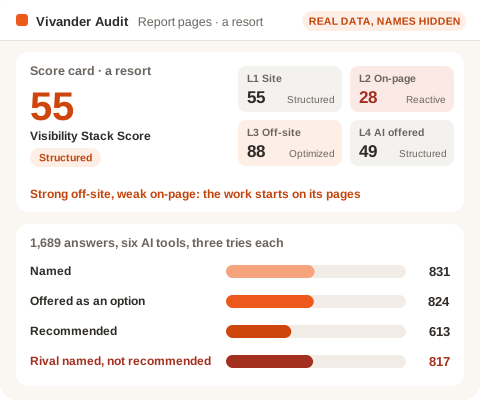
Score card · a resort
Visibility Stack Score55 · Structured
L1 Site Foundation55 · Structured
L2 On-Page Answer Quality28 · Reactive
L3 Off-site Corroboration88 · Optimized
L4 AI Offered Rate49 · Structured
Strong off-site, weak on-page: the work starts on the resort's own pages.
Recommendation funnel · the same resort
1,689 answers across six AI tools, three per question. Recognized by name in 144 of 144 questions.
Named831
Offered as an option824
Recommended613
Rival named, hotel not recommended817
By AI tool · a restaurant
AI tool
Runs
Named
Offered
Recommended
Rival named
Gemini
213
75.6%
75.1%
60.6%
30.5%
Claude
213
58.2%
57.7%
45.5%
23.5%
Perplexity
213
45.5%
44.1%
27.7%
21.6%
Google AI Overviews
149
36.2%
31.5%
19.5%
13.4%
Google AI Mode
213
30.5%
30.5%
23.5%
21.6%
ChatGPT
213
24.9%
24.9%
13.1%
23.0%
Known by name
A restaurant AI recognized in 349 of 353 runs when asked by name.
Rarely chosen
The same restaurant was visible in 9.4% of answers when the buyer left the name out.
How the documents lay it out: Harbor Light Inn, a fictional inn
The score card, the funnel and a finding
Example, illustrative data
Sample score card
46
Visibility Stack Score, out of 100
Structured
Layer 1 · Site foundation64 · Integrated · weight 30
How the example adds up: 0.30 × 64 + 0.25 × 44 + 0.25 × 40 + 0.20 × 31 = 46.4, shown as 46. Layer 1 is above the gate of 30, so Layer 2 counts in full.
Example, illustrative data
Sample funnel
60 unbranded questions on 7 platforms make 420 pairs. A pair is one question on one platform, asked three times.
A result counts when it holds in two of the three tries.
Asked420 pairs
Mentioned130 of 420 · 31 percent
Recommended58 of 420 · 14 percent
Cited your site41 of 420 · 10 percent
Brand questions, recorded and not scored: 20 questions on 7 platforms, 140 pairs. The example inn was mentioned in 131 of them.
Read together, the two sets show that AI knows the business. It offers the inn in about a third of the pairs where the buyer leaves the name out.
Example, illustrative data
Sample results, platform by platform
Example results for the fictional Harbor Light Inn on each of seven AI platforms, 60 unbranded questions each
Platform
Pairs
Mentioned
Cited your site
Recommended
Competitor named most often
ChatGPT
60
24
6
12
Quayside Hotel (31)
Claude
60
15
2
6
Seaglass Suites (22)
Perplexity
60
22
11
9
Quayside Hotel (27)
Gemini
60
18
6
8
Marrow Point Lodge (24)
Google AI Overviews
60
17
8
7
Quayside Hotel (25)
Google AI Mode
60
19
7
9
Seaglass Suites (23)
Microsoft Copilot
60
15
1
7
Quayside Hotel (26)
All seven
420
130
41
58
Quayside Hotel (160)
Every cell opens, in the data room and on the platform, to the questions and the full answers behind it.
Example, illustrative data
Sample finding and its action
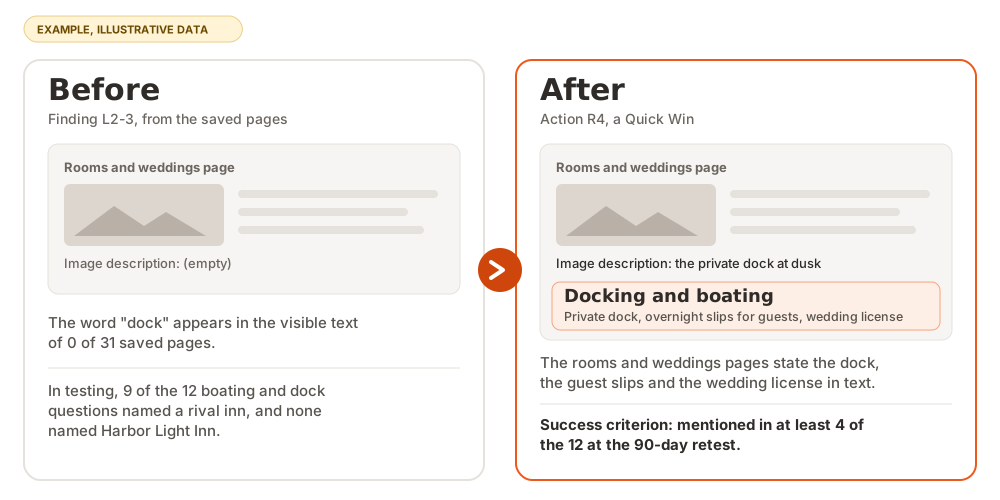
L2-3The private dock is shown in photographs and never stated in page text.
Evidence
The word "dock" appears in the visible text of 0 of 31 saved pages. Six gallery images show the dock, with empty image descriptions.
What we observed
In testing, 9 of the 12 boating and dock questions named Seaglass Suites or Marrow Point Lodge, and none named Harbor Light Inn.
Action
R4 Add a "Docking and boating" section to the rooms and weddings pages stating the private dock, overnight slips for guests, and the wedding license that covers the lawn and the dock.
Tier
Quick Win
Owner and effort
Marketing manager, about two hours
Control
Property: the inn can make this change itself
Number it moves
Mentioned pairs on the 12 boating questions
Success criterion
Mentioned in at least 4 of the 12 at the 90-day retest
The same finding, drawn as the change it asks for. The result is measured at the 90-day retest.
Example, illustrative data
Sample rows from "What AI knows"
Example fact-check rows for the fictional Harbor Light Inn
Fact
Verified
What AI said
Verdict
Private dock with guest slips
Yes. Not stated in the site's text
"Does not have its own dock" (Gemini, 2 of 3 tries)
Stated wrong. Fix by publishing
Rooms
38
"38 rooms" (ChatGPT, 3 of 3)
Stated correctly
Year opened
1998
"Opened in 2005" (Copilot, 2 of 3)
Stated wrong
Dogs
Welcome in four ground-floor rooms
Perplexity: "pet friendly"; AI Overviews: "no pets"
Platforms disagree
Wedding license
Lawn and dock
Not mentioned by any platform
Not stated
Want to see how real audits read, with names removed?
Each finding names what is wrong, shows the evidence we captured, and states the fix.
The examples below are anonymized and generalized from the checks the audit runs.
They are examples, not records from a named client.
They apply to any business a buyer chooses by asking.
Technical SEO: can AI reach and read your site?
AI crawlers turned away at the edge
The evidence
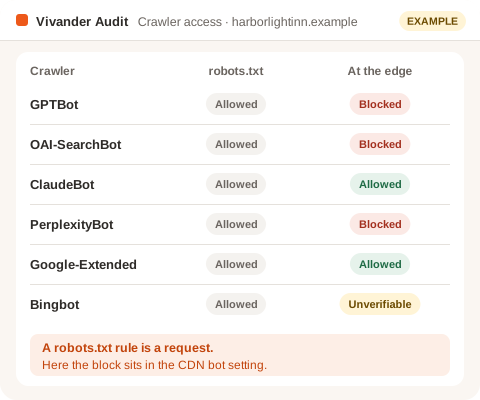
Robots.txt allows every crawler. Fetched as each AI crawler, the home page and top twenty pages returned a block page for three of them.
The block came from a bot-protection setting at the content delivery network. Each crawler is recorded as confirmed allowed, confirmed blocked or unverifiable.
The fix
Allow the AI crawlers you want in the CDN or firewall rule, then re-fetch as each crawler to confirm.
A rule in robots.txt is a request. The edge is where access is enforced.
Schema missing or added only by script
The evidence
The raw HTML of the location pages carries no LocalBusiness or Organization markup.
The markup appears only after a tag manager runs in the browser, so a reader that does not run JavaScript sees none.
The fix
Publish the structured data in the server-rendered HTML, with address, hours, phone and the profiles that describe you in sameAs.
Main content rendered only in JavaScript
The evidence
Fetched with JavaScript off, the services page returns a header, a footer and an empty container. The text a buyer reads exists only after scripts run.
The fix
Render the primary content on the server, or pre-render the pages that answer buyer questions.
Slow on a phone
The evidence
Largest Contentful Paint of 5.8 seconds on mobile against 1.9 on desktop, with a hero image as the largest element.
Each figure is labeled lab or field. A site with no field data is reported as lab only.
The fix
Compress and size the hero image, defer the scripts ahead of it, then re-measure on the same test.
Example: robots.txt allows a crawler that the edge blocks.
Examples
AEO: do your pages answer the questions buyers ask?
Four examples of pages that hide or bury the answer a buyer wants.
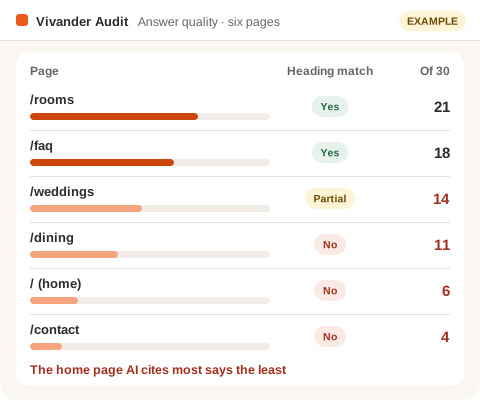
No heading matches a buyer question
The evidence
Every heading on the site was mapped against the full set of buyer questions in the audit.
Fewer than one in five questions had a matching heading. Headings read "Our Story" and "Experience the Difference."
The fix
Rename or add headings in the words buyers use, such as "How far is it from the airport?" or "What does a consultation cost?"
The answer arrives after the context
The evidence
On the pricing page, the price first appears in the fifth paragraph, after the history of the business. The page is scored as a partial answer.
The fix
Put the answer in the first sentence under the heading, with the specifics (price, time, place). Keep the context below it.
Key facts behind tabs and accordions
The evidence
Parking, cancellation terms and accessibility details sit inside collapsed panels. We open every panel by hand to read them.
A fact that no crawl method could read is reported, because AI systems may not read hidden content.
The fix
State the critical facts in visible text on the page, and keep the accordion for detail.
A page that answers a question nobody asks
The evidence
A long page titled with an internal program name matches none of the buyer questions. The question buyers do ask has no page.
The fix
Rewrite the existing page around the question buyers ask, in their vocabulary. No new page is needed.
Example: answer quality for six pages, with heading matches.
Examples
GEO: do the sources AI trusts describe you correctly?
Four examples from the sites AI reads about you.
Absent from the sites AI cites
The evidence
In testing, the answers that recommended a rival cited two review sites and a regional directory.
The business has no listing on one of them and an unclaimed listing on another.
The fix
Create and claim the listings, starting with the sources cited in the answers you lost.
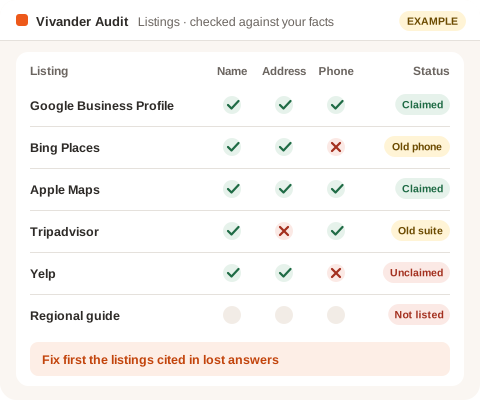
Name, address and phone disagree
The evidence
Each directory is recorded with its URL and a match against your verified facts: yes, partial or no.
Two directories carry a former phone number, and one carries an old suite number.
The fix
Correct the listings, beginning with the ones that feed the AI tools. Keep one verified record to check against.
AI repeats a wrong fact, and we find its source
The evidence
In testing, two AI tools stated the business closes at 6 p.m. The cited source was an outdated travel listing.
Each wrong statement is logged with the tool, the question, the time, the cited source and the correct fact.
The fix
Ask the source to correct its page, and publish the correct fact on your own site in plain text.
Nothing independent to corroborate you
The evidence
We swept knowledge graphs, national and regional publishers, vertical directories, review sites, forums and social channels.
The sweep found self-published profiles, and no third-party coverage that adds detail about the business.
The fix
Earn coverage that states specifics a business cannot credibly say about itself: a trade feature, a local news story, a named expert quote.
Examples only. Figures and wording are illustrative and anonymized.
In a delivered audit, every finding carries a code, links to the stored capture that shows it, and states what would prove it wrong.
Example: listings checked against the verified facts.